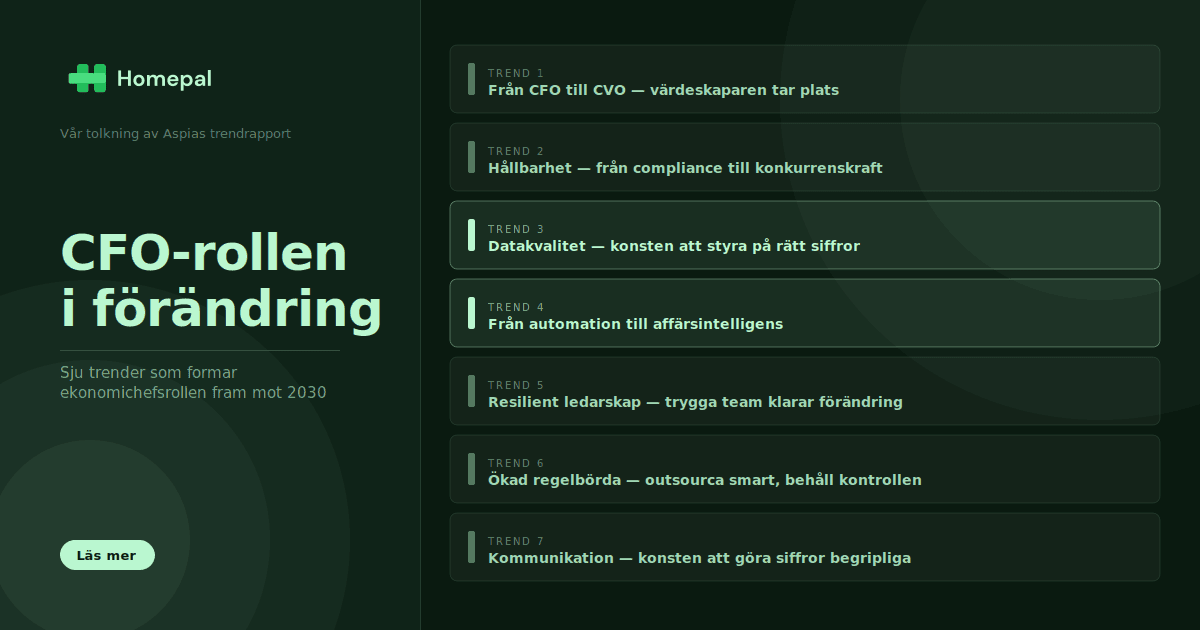
Trend 1: From Financial Control to Strategic Value Creation
Perhaps the most important trend is the one concerning the role itself. CFOs are no longer expected to simply report on the past—they are expected to help shape the future. Aspia summarizes this with the term CVO, or Chief Value Officer: a role that actively drives issues related to business models, pricing, and investments rather than simply following up on what has already happened.
For real estate companies, this is more concrete than it sounds. Issues related to rent setting, maintenance investments, and portfolio allocation are directly linked to net operating income. But this requires that the CFO actually has access to the right decision-making data—in real time, not four weeks later.
This is exactly the shift we’re seeing at the real estate companies that work with Homepal. Stockholmshem saved 10 million kronor in six months. Mimer reduced rent losses by 5.15 million in eleven months. They are not exceptions—they are what happens when the finance department stops merely tracking net operating income and starts improving it.
→ Read about how Stockholmshem works → Read about how Mimer reduced rent losses
Trend 2: Sustainability Belongs in Business Decisions
CSRD, the taxonomy, energy performance certificates. Real estate companies are in the midst of sustainability reporting, which is currently perceived primarily as an external requirement. But the trend highlighted in the report points to something else: that sustainability data, when properly structured, actually helps drive wiser business decisions.
For real estate companies, this means that energy data, maintenance patterns, and service requests aren’t just ESG reporting—they’re clues to where value is being created or lost within the portfolio. This requires the same precision in data collection and structure as financial reporting. And it requires that the two narratives—the financial and the sustainability narrative—are actually linked within the same system.
Trend 3: Data Quality Is Not an IT Problem
One of the trends hitting real estate companies the hardest is the issue of data quality. The report confirms something that many finance departments recognize: the problem isn’t a lack of data. It’s a lack of the right data.
Real estate companies often sit on enormous amounts of operational data, fault reports, energy consumption figures, and financial key performance indicators—but how much of it is actually used to inform decision-making? And does everyone in the organization agree on what these key performance indicators actually measure?
Jens Wikman, CFO at Aspia Group: “The data can be extremely detailed, but it provides no value if we don’t question what exactly is being reported.”
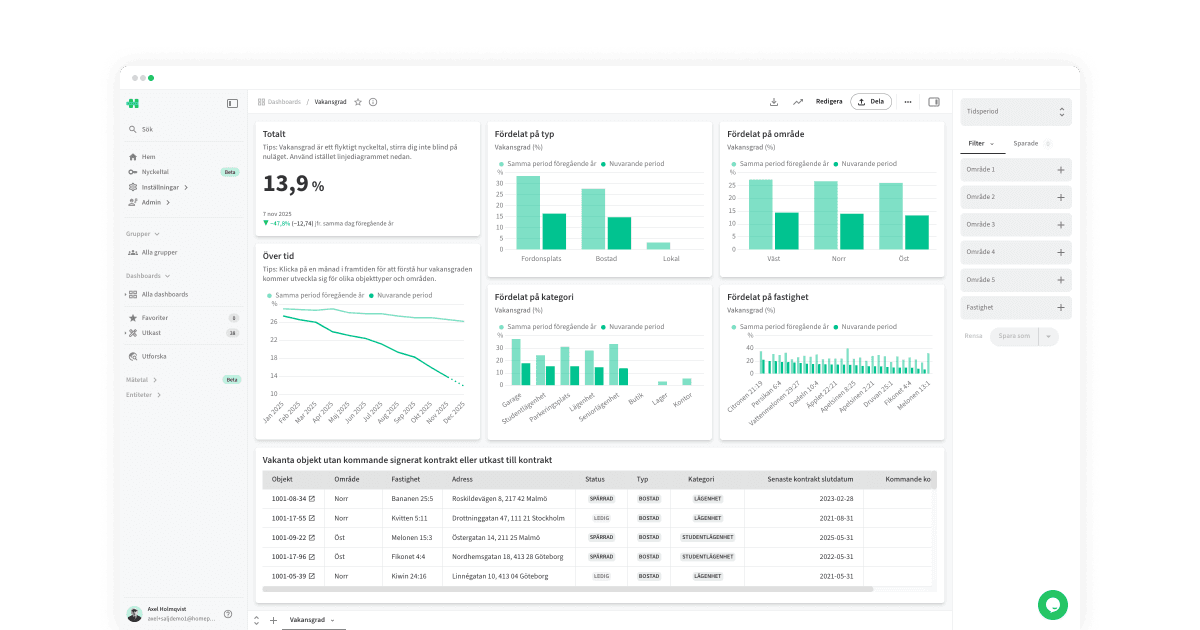
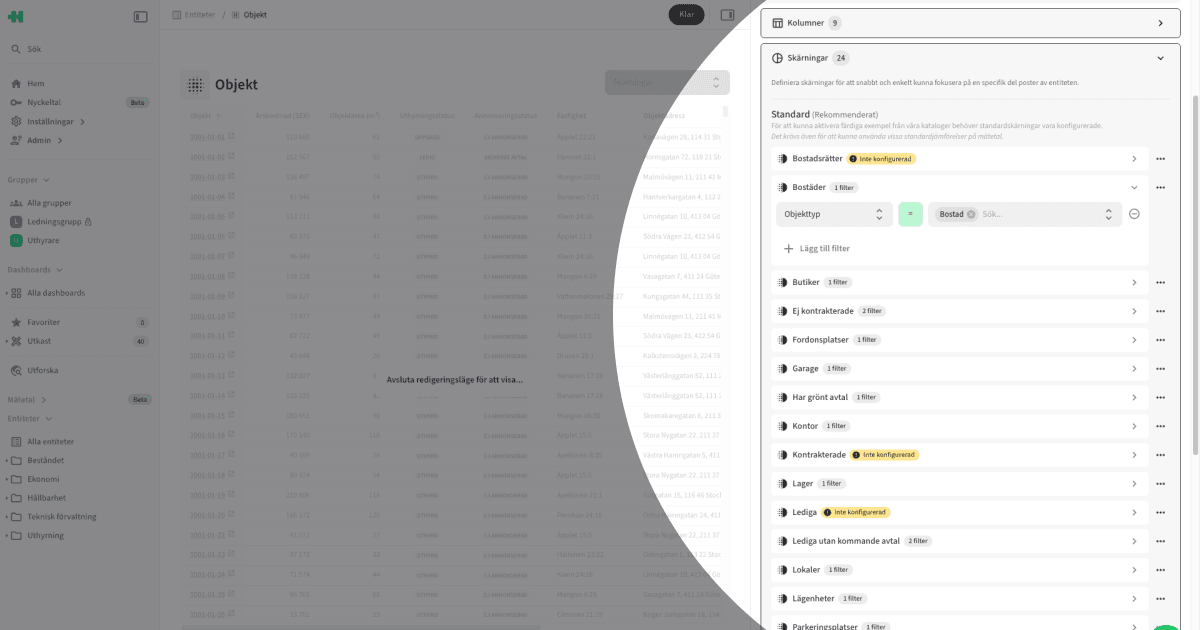
That’s exactly what the key metric trees in Homepal are designed to solve. Instead of each department and property manager defining their own metrics—and no one really knowing if they’re talking about the same thing—you establish a common framework for how net operating income, vacancy rates, and NKI are measured and broken down. Everyone works toward the same version of the truth, from the board level down to individual property managers.
→ See how key metric trees work in Homepal
Trend 4: AI frees up time—but critical thinking must not be neglected
The report is clear: AI is a tool, not an answer. A critical eye has never been more important—the less subject matter expertise you have, the harder it is to spot errors in what the AI produces.
We agree. That’s also why Homepal’s AI insights aren’t generic summaries. They are specific, proactive alerts based on your actual portfolio data: Fault reports at Björkgatan 4 have increased by 34% over the past 30 days. This typically precedes an increase in vacancies by 60–90 days. It’s not AI that answers questions—it’s AI that asks them for you, before you even knew you should ask them.
It still requires a critical eye. But it’s easier to scrutinize a specific insight about your own properties than a general AI response about the real estate industry as a whole.
Trend 5: Resilience Is Built on People, Not Systems
One of the more unexpected trends revolves around the human element. Finance departments that operate in silos, isolated from the rest of the business, are more vulnerable when conditions change. It’s essential to build cross-functionally—so that the finance department understands property operations and vice versa.
This places demands on leadership. Psychological safety, continuous learning, and room to fail are not just “soft” values—they are prerequisites for the function to navigate change.
Trend 6: Outsource Non-Core Activities
Three out of four Swedish companies report that reporting requirements have increased in recent years. For real estate companies with limited finance teams, this is a significant burden. The report points to outsourcing as a solution—but with a clear boundary: strategic governance and control over data should never be relinquished.
Invoice processing, day-to-day bookkeeping, and tax consulting can be effectively handled externally. Analysis of net operating income, portfolio performance, and investment rationale should be managed internally. And that requires tools that make such analysis possible without a large team of analysts.
Trend 7: Numbers Aren’t Enough—You Need the Story
The final trend is about communication. Today, CFOs are expected to deliver not just numbers, but the story behind them—to the boardroom, the executive team, and an operational organization that must make decisions based on financial data they may not be trained to interpret.
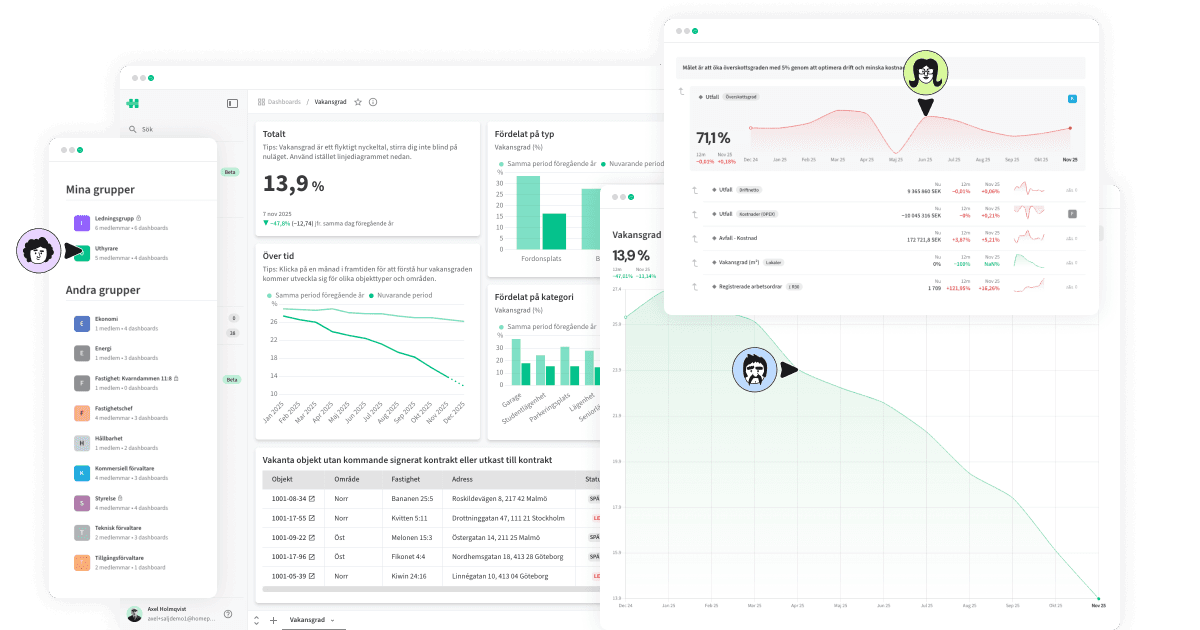
This requires tools that present data in a way that is actually understandable to the recipient. A portfolio manager doesn’t need to see the same view as the CFO. A board member doesn’t need to be overwhelmed by raw data to understand the portfolio’s direction.
In Homepal, you can build views tailored to specific roles and areas of responsibility—with data that’s always up to date. That way, the CFO can tell the story behind the numbers, rather than explaining why they aren’t up to date.
→ See how reporting and views work in Homepal
What This Means for You
These seven trends all point in the same direction: the finance function’s most important contribution is not to track what has happened, but to shape what will happen. For real estate companies that want to make this shift, they need the right data, the right tools, and an organization that truly understands what the numbers are telling them.
That’s exactly what we’re building at Homepal.