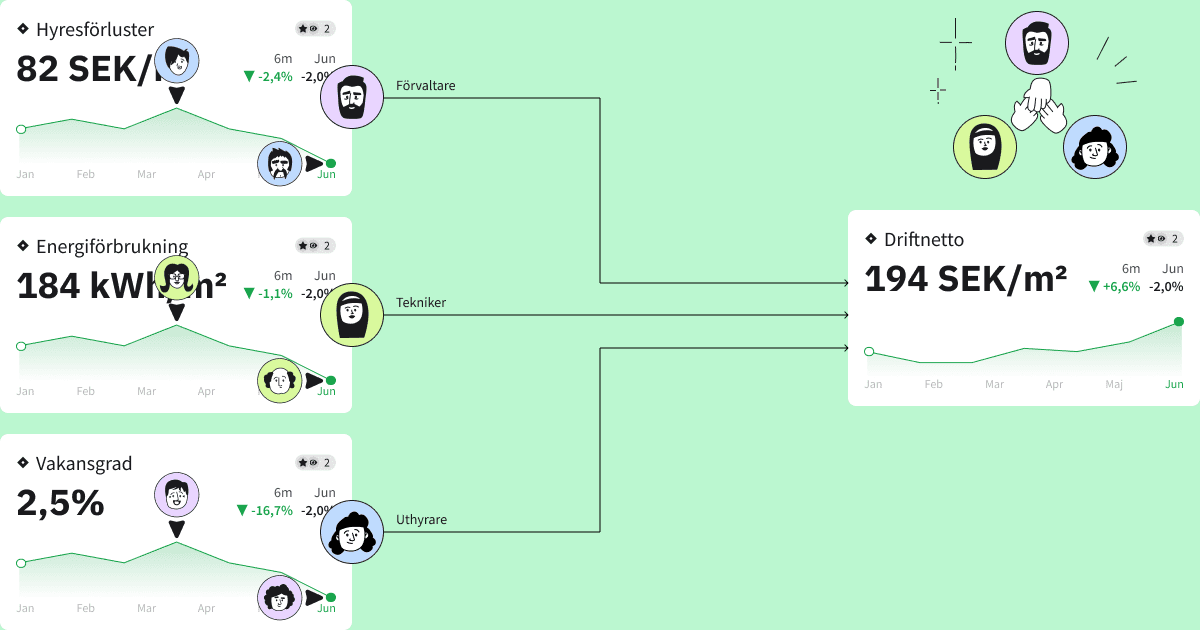
Net operating income is a property's rental income minus operating and maintenance costs and property tax. It shows what the property actually generates before financing and depreciation, and it is the figure an investor values the property on.
How to calculate net operating income
Net operating income = rental income − operating costs − maintenance costs − property tax
Rental income is counted after vacancies and rent losses, meaning the income the property actually collected.
A worked example
A residential property with 40 apartments and 2,800 square metres of living area.
Item | Amount |
|---|---|
Rental income | SEK 4,200,000 |
Rent loss from vacancies | −SEK 120,000 |
Operating costs | −SEK 1,580,000 |
Maintenance | −SEK 650,000 |
Municipal property fee | −SEK 66,000 |
Net operating income | SEK 1,784,000 |
That works out to SEK 637 per square metre. At a market value of SEK 44.6 million, the net operating income corresponds to a yield of 4.0 percent.
The figures are an example. Levels vary widely between locations, construction years and segments.
What counts as an operating cost?
Included | Not included |
|---|---|
Heating, electricity, water and waste | Interest and loan repayments |
Property care and cleaning | Depreciation |
Repairs and planned maintenance | Investments that raise the standard |
Insurance | Corporate tax |
Property administration | Group overheads, where the company places them outside |
The last row causes the most confusion. Some companies deduct central administration before net operating income and others after. Before you compare two companies, check which definition each of them uses.
What counts as a good net operating income?
A single figure says nothing without comparison. Net operating income per square metre makes properties of different sizes comparable. The operating margin, meaning net operating income divided by rental income, often lands between 40 and 55 percent for residential properties and higher for public-sector and logistics properties. The trend over time says the most, since a net operating income that falls two years running points to something you can act on.
Learn about more important KPI's in the real estate industry here
How net operating income affects property value
Market value is the price that would reasonably be paid in a sale on an open market. The price is the actual outcome, and it is shaped by the buyer's assessment of future net operating income and risk.
Yield is net operating income divided by market value. It describes what the property returns in relation to what it costs.
The yield requirement is the return an investor demands. It is set from the risk in the individual property, where the level, length and tenants of the leases are weighed together with location, market development and the character of the property.
The difference between the last two is simple. The yield is the market's assessment of the situation as it stands. The yield requirement is what a rational investor considers the return ought to be.
The consequence is that the safer the net operating income is judged to be, the lower the yield requirement an investor accepts, and the higher the value. Long municipal leases, housing shortages in the local market and a growing logistics market are examples of conditions that have led investors to believe in stable net operating income over time.
Distribution keys
When you track net operating income at property level, you meet two kinds of cost.
Direct costs belong to one specific property, such as heating and electricity. They are booked to a cost centre and need no allocation.
Common costs are spread across the whole portfolio, such as central administration. How they are allocated decides whether the picture of the individual property is fair. Distribution keys are used for that, usually based on area, number of apartments or rental income. Pick the wrong key and a property can look unprofitable even though it performs well.
Read more about distribution keys here
From tracking net operating income to improving it
Calculating net operating income is easy. Seeing what drags it down is harder, because the causes sit spread across finance systems, leasing and work orders. Mimer cut its rent losses by SEK 5.15 million by connecting those sources and acting on what they saw. Read how here
Frequently asked questions
What is included in net operating income?
Rental income after vacancies, minus operating costs, maintenance and property tax. Interest, depreciation and tax on profit are not included.
How do you calculate net operating income per square metre?
Divide the net operating income by the property's lettable area. The measure makes properties of different sizes comparable.
What is the difference between net operating income and cash flow?
Net operating income stops before financing. Cash flow also counts interest, loan repayments and investments.
Is maintenance part of net operating income?
Ongoing and planned maintenance is deducted. Investments that raise the property's standard are not.
How do vacancies affect net operating income?
Every empty apartment lowers rental income while the operating costs stay where they are, so vacancies hit straight through.